



 World Opinion | Alternative Média Débats De Société, Questions, Opinions et Tribunes.. La Voix Des Sans-Voix | Alternative Média
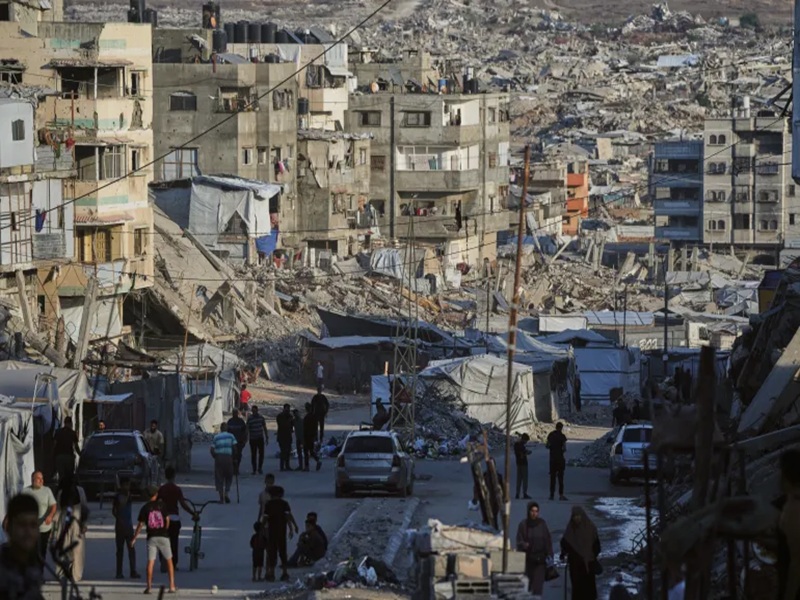
War has devastated Gaza’s economy, education, healthcare, infrastructure and public services, transforming how Palestinians live, work, learn and survive.
Three years after Israel launched its genocidal war on Gaza following the Hamas-led October 7, 2023 attack on Israel, the Palestinian enclave has been transformed beyond recognition.
Israel’s sustained aerial and ground assault has devastated vast parts of the Gaza Strip, destroying homes and neighbourhoods and severely damaging its infrastructure and essential services.
The war has shattered the lives of a population of around two million people. Repeated displacement and evacuation orders have uprooted families and communities, while more than 74,245 Palestinians have been killed, according to Gaza’s Ministry of Health.
Although a “ceasefire” was announced in October 2025, it has not brought an end to the suffering. The Ministry of Health says 1,462 Palestinians have been killed since the “ceasefire” took effect, while Israeli attacks and other military activity have continued across the Strip.
Years of war have brought the collapse of education, healthcare and the economy, while access to food, water, shelter and other basic necessities has become a daily struggle.
Surviving daily life
For people in Gaza, the war has changed not only where they live, but how they carry out the most ordinary parts of daily life.
A home, running water, electricity and a mode of transport – the basic infrastructure of everyday life – no longer exist for many Palestinians in Gaza.
In September, according to the UN, 94 percent of Gaza’s population remained in urgent need of shelter and basic household assistance, while 65 percent of households were living in tents or makeshift shelters offering little protection from the elements, having been forced from their homes by Israeli attacks or forced evacuation orders.
Advertisement
Many families also lacked adequate bedding, lighting, kitchen equipment and sanitation facilities, according to the United Nations.
Get instant alerts and updates based on your interests. Be the first to know when big stories happen.Yes, keep me updated
Water has become another daily challenge. Ninety-one percent of assessed households experienced moderate-to-high water insecurity in early August, up from 84 percent in June, according to the UN.
Electricity is similarly unreliable. Gaza has remained without a functioning electricity grid, leaving essential services and households dependent on generators and increasingly scarce fuel, engine oil and spare parts.
Damaged roads and communications networks have also made transport, phone and internet access and access to basic services more difficult.
The result is a daily life reorganised around survival: collecting water, charging a phone, cooking, washing and moving between services all require resources and planning that were once unnecessary.

Economic grief
Gaza’s economy has been devastated by the war, with the destruction of businesses and local industries leaving families with little income and sharply reduced purchasing power.
In September, the UN Conference on Trade and Development estimated that 92 percent of Gaza’s economic establishments had been damaged or destroyed since October 2023, while unemployment had reached 78 percent.
GDP per capita stood at just $212 in 2025, around 17 percent of its 2022 level. Agriculture and industry were each operating at just 6 percent of their 2022 output, while construction had fallen to 1 percent.
The economic collapse has also made basic goods increasingly unaffordable. Restrictions on the movement of goods have deepened the damage to Gaza’s economy, where most goods traded with the outside world have historically passed through Israeli-controlled crossings.
The impact has been felt directly by consumers. In September, prices remained around 200 percent above pre-October 2023 levels, according to the UN.
As jobs and incomes have disappeared, economic activity has increasingly centred on aid, debt and small-scale informal work. Economic researcher Rami al-Zaygh told Al Jazeera that the war had “pushed society back decades”, reviving old professions and creating new types of work using basic tools and whatever resources are available.
Many families in Gaza now rely on cash assistance from humanitarian groups. Physical cash itself has become increasingly scarce, with people using digital payments and e-wallets instead.
Struggle to study
The war has drastically changed education in Gaza. For nearly three years, hundreds of thousands of children had no regular access to in-person schooling as schools were damaged or destroyed, while many of those still standing are used as shelters.
Nearly 98 percent of schools have been damaged or destroyed, according to UNICEF. As of April 2026, around 700,000 children aged 4 to 17 had missed almost three consecutive years of in-person education.
Instead of returning to classrooms, many children have been learning in tents and temporary learning spaces. Around 200,000 children have no access to education.
The disruption has also widened the gap in children’s learning. The Palestinian Ministry of Education has warned of a serious loss of basic skills and a growing academic gap, with nearly three years of interrupted education threatening the long-term educational prospects of an entire generation.

Healthcare decimated
Gaza’s health system has been pushed close to collapse.
All 36 of Gaza’s hospitals have been damaged, and only 19 are currently functioning, according to the World Health Organization. None is operating at full capacity.
The few facilities still operating are struggling with severe shortages of essential medicines, medical equipment, diagnostic supplies and fuel. These shortages have disrupted cancer treatment, dialysis and care for people with chronic diseases.
Access to treatment outside Gaza has also remained limited. Since October 2023, about 12,400 patients have been medically evacuated, but the WHO says tens of thousands more still require specialised care unavailable inside the Strip.
The collapse of the health system, combined with deteriorating living conditions, has also created increasingly dangerous public health conditions.
The WHO warned in September that overcrowding, inadequate shelter, water and sanitation were increasing the risk of disease outbreaks.
It said the health system was not equipped to cope with these growing risks and called for sustained humanitarian access, essential medicines and equipment, rehabilitation of health facilities and expanded medical evacuations.
A shrinking space
Gaza’s geography has been transformed by the war. Israeli military control and access restrictions have divided the territory, pushing Palestinians into an increasingly smaller area while cutting them off from homes, farmland and vital facilities.
The so-called Yellow Line is a military demarcation inside Gaza marking areas of Israeli military deployment and restricted access. Since it was established under the October 2025 “ceasefire”, Israel has moved it deeper into populated areas, forcing families to leave.
In September, Euro-Med Human Rights Monitor said Israeli military control and access restrictions covered around 70 percent of Gaza, leaving more than two million Palestinians concentrated in less than 30 percent of the Strip.
Rafah is one of the clearest examples of this transformation. Located in southern Gaza along the border with Egypt, the city became a refuge for more than one million Palestinians displaced from across the Strip during the war.
In May 2024, Israel’s military operation in Rafah displaced more than 800,000 people, according to the UN. Today, almost all of Rafah, except for the western area, Mawasi Rafah, is under Israeli control, leaving Palestinians displaced from the city unable to return to their homes.
Advertisement
Euro-Med warned on September 29 that the expansion of Israeli-controlled areas was entrenching forced displacement, denying Palestinians access to their homes and land and leaving them without guarantees of return.
Security and governance
Before the war, Hamas had governed Gaza since 2007, running its civilian administration and security services. The war has disrupted that system, leaving Gaza with a severely degraded civilian administration.
In July, Hamas announced that it would hand administrative powers to the National Committee for the Administration of Gaza (NCAG), a Palestinian technocratic body established under the post-war plan. But the transition has yet to take place.
The war has also weakened the systems responsible for maintaining public order.
Israeli forces have repeatedly attacked police officers and security posts. The UN Human Rights Office recorded at least 12 attacks on police between January and May 2026, killing 53 people, including 35 police officers. The targeting of public governance institutions had contributed to chaos and undermined civilian protection, the UN said.
The Palestinian Centre for Human Rights has similarly warned that attacks on police and security personnel have weakened Gaza’s civilian protection system, contributing to a security vacuum, kidnappings, attacks on property and looting of humanitarian aid.
For people in Gaza, three years of war have left behind a sense of uncertainty with no clear path forward.
World Opinion + Aljazeera